
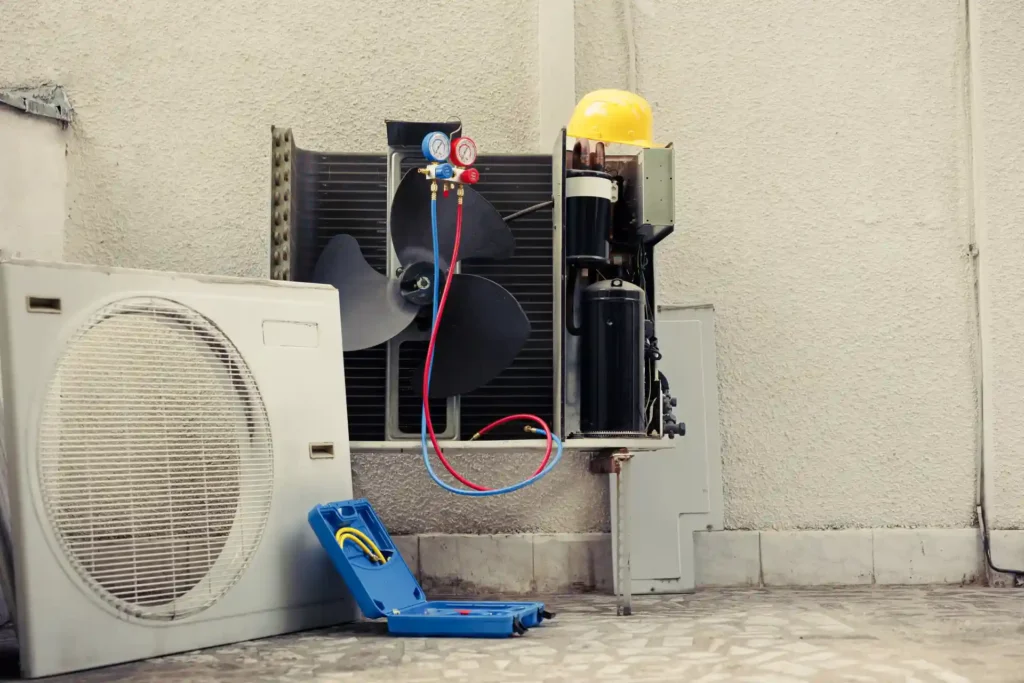
How to Check AC Gas Leakage?
I know you are worry about checking your AC gas leakage. Let’s make it simple and clear in this blog:
To check AC gas leakage, look for warm air from vents, ice buildup on copper pipes, hissing sounds near the unit, and a sudden spike in your electricity bill. A licensed HVAC technician confirms the leak using manifold pressure gauges, the only definitive test. In Dubai, where summer temperatures hit 46°C, catching a refrigerant leak early prevents compressor failure and saves thousands in repair costs.
Quick Overview:
- Feel the air, if warm output from a running AC signals low refrigerant.
- Inspect copper pipes for oil stains, frost, or visible corrosion.
- Listen for hissing or bubbling sounds near indoor and outdoor units.
- Check your DEWA bill, a 20-40% spike often points to gas loss.
- Book a pressure test, a technician uses manifold gauges for confirmation.
- Refrigerant handling requires a licensed contractor in Dubai.
- Delayed repairs turn a AED 300 fix into a AED 3,000+ compressor replacement.
Now its detail time, starting with the causes of gas leakage.
What are the Causes of AC Gas Leakage?
Refrigerant absorbs heat from inside your room and dumps it outside through a continuous cycle. When the sealed loop develops a crack, hole, or loose fitting, gas escapes, and your AC slowly loses its ability to cool.
The most common causes of refrigerant leaks in Dubai:
- Vibration wear on copper pipe flare fittings over time
- Corrosion from Dubai’s humid, salt-laden coastal air, especially in Marina, JBR, and Palm Jumeirah properties
- Poor installation under-torqued or improperly flared pipe connections (the leading cause in buildings under 5 years old)
- Rodent damage to exposed piping in older villas
- Age-related metal fatigue, units over 8–10 years old are high-risk
The leak itself is invisible and odorless. You can’t see it or smell it, but your electricity bill and your comfort level will both notice it quickly.
7 Warning Signs Your AC Has a Gas Leak
It is my expert advise to catch these AC gas leakage signs early. They appear weeks before a complete breakdown.
- Warm air from vents: The most obvious sign. If your AC blows air that feels more “ceiling fan” than “Arctic,” low refrigerant is suspect number one.
- Ice or frost on copper pipes or the indoor coil: Counterintuitive but real. Low gas pressure drops the evaporator temperature below freezing, causing ice buildup.
- Hissing or bubbling sounds: Refrigerant escaping under pressure sounds like a slow puncture. Most audible near pipe connections and valve fittings.
- Skyrocketing DEWA bills: A gas-depleted AC works 30-50% harder and still can’t reach the target temperature, burning significantly more power.
- AC runs continuously without cooling: The unit keeps trying but can’t reach the set temperature without enough refrigerant.
- Water pooling around the indoor unit: Frozen coils melt and drip onto your floor. This is both a symptom and a secondary damage risk.
- Uneven cooling across rooms: Rooms farthest from the unit lose cool air first as refrigerant pressure drops.
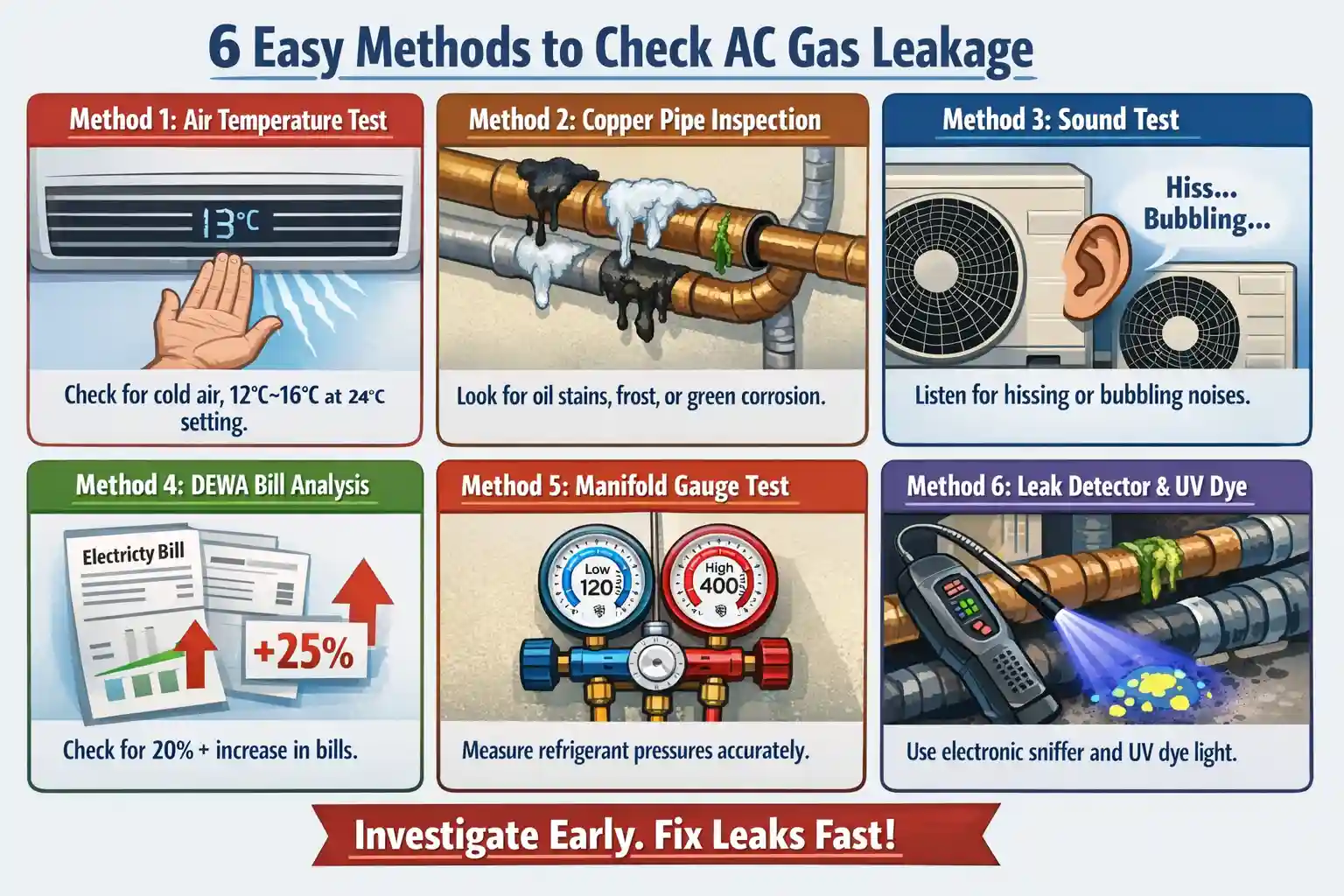
6 Easy Methods to Check AC Gas Leakage
Based on my experience I have listed 6 methods to check the AC gas leakage that work in almost every case.
Method 1: Air Temperature Test
Hold your palm directly in front of the AC vent within 2 minutes of startup. A properly charged split AC at a 24°C setting should deliver air at 12°C–16°C from the vent. If the air feels closer to room temperature, rule out a clogged filter first clean it, run the unit again, and if the problem persists, move to the next method.
Method 2: Copper Pipe Visual Inspection
Trace the refrigerant lines from your indoor unit to the outdoor compressor. Look specifically for:
- Oil stains or greasy residue around joints and valve connections refrigerant oil escapes alongside the gas
- Frost or ice on the suction line (the thicker, insulated pipe) or indoor coil
- Greenish corrosion on copper fittings, particularly common in coastal Dubai areas
Any of these is strong physical evidence of a leak.
Method 3: Sound Test
Run the AC at maximum cooling for 10 minutes, then stand quietly near both the indoor and outdoor units. A refrigerant leak under pressure produces a faint hissing or bubbling sound near the escape point most often at pipe connections, flare fittings, or the Schrader valve on the outdoor unit. Works best in a quiet room and is surprisingly reliable for locating larger leaks.
Method 4: DEWA Bill Analysis
Compare your last three monthly electricity bills. A jump of 20% or more during a period of consistent usage habits (same occupancy, same thermostat settings) is a reliable indirect indicator of refrigerant loss.
Method 5: Manifold Gauge Pressure Test
A certified technician connects a manifold gauge set to the service ports on the outdoor unit and reads live refrigerant pressure. This is the definitive method for confirming how to check AC gas leakage accurately.
Normal operating pressures for R410A under Dubai ambient conditions:
| Pressure Side | Normal Range |
|---|---|
| Low side (suction) | 115–130 PSI |
| High side (discharge) | 375–425 PSI |
Readings significantly below these values confirm refrigerant loss. The test also detects air contamination a secondary problem common after large leaks.
Method 6: Electronic Leak Detector and UV Dye Test
For pinpointing small leaks that gauges can’t locate precisely, technicians use:
- Electronic refrigerant leak detectors handheld probes sensitive to refrigerant vapor concentrations as low as 3 grams per year
- UV dye kits fluorescent dye injected into the system, then revealed under a black light lamp as a glowing stain at the exact leak point
The UV dye method is preferred for systems with multiple small leaks, which is common in older Dubai villas with original copper piping. Don’t wait until your compressor surrenders in the middle of July, contact us now for expert ac service in Dubai.
DIY vs Professional Detection
| Method | Who Can Do It | Accuracy | Typical Cost |
|---|---|---|---|
| Air temperature test | Homeowner | Low | Free |
| Copper pipe visual inspection | Homeowner | Medium | Free |
| Sound test | Homeowner | Medium | Free |
| DEWA bill analysis | Homeowner | Low–Medium | Free |
| Manifold gauge pressure test | Licensed technician | Definitive | Included in service call |
| Electronic leak detector | Licensed technician | Very High | AED 200–400 |
| UV dye + black light test | Licensed technician | Very High | AED 250–450 |
Important: In Dubai, handling refrigerants without certification violates Dubai Municipality environmental regulations.
How Much Does AC Gas Recharge Cost in Dubai?
AC gas recharge in Dubai costs approximately AED 200-500 for split AC units and AED 500-1,500 for ducted or central systems, depending on refrigerant type, quantity required, and whether a physical leak repair is also needed.
Factors that affect the final price:
- Refrigerant type: R32 costs more per kilogram than R410A
- Quantity needed: A small top-up vs. a full recharge after a major leak
- Leak repair work required: Pipe soldering, valve replacement, or flare recutting adds labour cost
- Unit capacity: Larger tonnage systems require more gas
Always get a written quote before work begins, and confirm the contractor holds a valid Dubai Municipality trade license.
Conclusion
Knowing how to check AC gas leakage is one of the most practical things. The diagnostic process starts with simple, free checks you can do yourself and escalates to a professional manifold pressure test the moment a red flag appears. For licensed AC repair service in Dubai, contact Golden Spotless Technical Services a trusted name in residential and commercial HVAC maintenance across Dubai. Our certified technicians carry all equipment needed to detect, repair, and recharge your system in a single visit, and provide documented pressure reports with every job.
The golden rule: fix the leak first, recharge second. Topping up gas without sealing the source is money down the drain literally and figuratively.
FAQs
Q: How many kg of gas is in a 1.5 ton AC?
A 1.5 ton AC unit typically holds 0.7 to 1.2 kg of refrigerant gas, depending on the brand, model, and refrigerant type. Units running R410A generally require around 0.9-1.1 kg, while R32 systems use slightly less around 0.7-0.9 kg.
Q: Is AC gas harmful if inhaled?
Modern AC refrigerants (R410A and R32) are not acutely toxic, but they are not safe to inhale either. In open, well-ventilated spaces, brief exposure to trace amounts is unlikely to cause harm. However, in an enclosed room, a significant leak displaces oxygen and can cause dizziness, shortness of breath, headaches, and in extreme cases, loss of consciousness.
Q: How can I confirm a gas leak in my AC?
The only way to definitively confirm an AC gas leak is a manifold gauge pressure test performed by a licensed HVAC technician. The technician connects a gauge set to the high-side and low-side service ports on the outdoor compressor unit. If the readings fall significantly below the normal range for your refrigerant type (below 115 PSI on the low side for R410A systems) refrigerant loss is confirmed.
Q: What tools do professionals use to detect refrigerant leaks?
The three primary tools are manifold gauge sets (to measure system pressure), electronic refrigerant leak detectors (to sense escaping vapor down to 3 grams per year), and UV dye kits with black light lamps (to pinpoint exact leak locations). Manifold gauges confirm gas loss; the detector and UV dye identify precisely where it’s coming from.
Q: How often should AC gas be refilled in Dubai?
A properly installed, well-maintained AC should never need a refrigerant top-up. Refrigerant doesn’t get consumed, it circulates in a sealed loop. If you’re refilling gas every season, there is an active leak that needs to be found and repaired, not just repeatedly recharged.


