
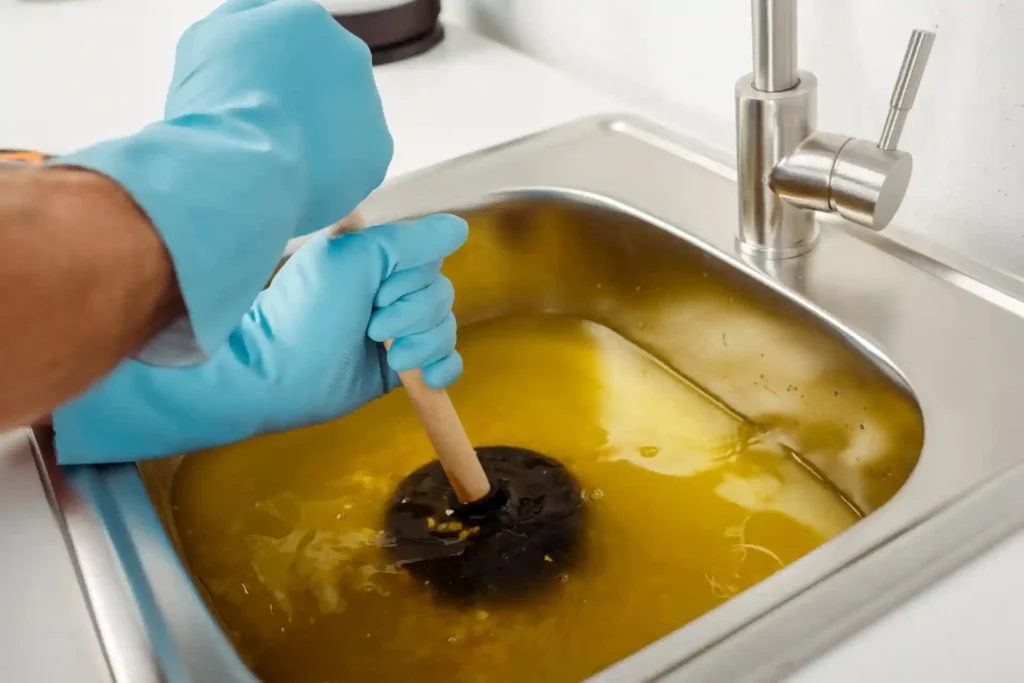
How to Unclog a Sink?
To unclog a sink, start by pouring boiling water down the drain, then use a plunger to break up the blockage. If that fails, apply a baking soda and vinegar solution, or manually clear the P-trap under the sink. Most sink clogs clear within 30 minutes using household tools.
Here is a quick overview of different methods to unclog a sink:
| Method | Best For | Time Needed | Tools Required |
| Boiling water flush | Grease and soap buildup | 5 minutes | Kettle or pot |
| Plunging | Soft blockages near drain opening | 10–15 minutes | Cup plunger |
| Baking soda + vinegar | Mild organic clogs and odor | 20–30 minutes | Measuring cup, kettle |
| P-trap cleaning | Hair, solid debris, object removal | 20–30 minutes | Adjustable wrench, bucket |
| Drain snake / hand auger | Deep clogs past the P-trap | 30–45 minutes | Hand auger or drain snake |
| Wet/dry vacuum | Stubborn soft clogs | 10–15 minutes | Shop-Vac or wet/dry vacuum |
| Chemical drain cleaner | Last DIY resort (metal pipes only) | 30–60 minutes | Drano Max Gel or similar |
What Causes a Clogged Sink?
Understanding what causes a sink to clog helps you choose the fastest, most effective clearing method. The four most common causes are:
- Grease and fat buildup: Cooking oil, butter, and food fats solidify inside drain pipes at temperatures below 40°C. Over weeks and months, this creates a narrowing layer of buildup that eventually blocks flow entirely. Kitchen sinks clog from grease more than any other cause.
- Hair and soap scum: Bathroom sinks and shower drains accumulate hair strands that bind with soap residue to form dense, wet mats. A single strand of hair catches on a pipe fitting; within days, a mat forms. This is the leading cause of bathroom sink clogs.
- Foreign objects: Bottle caps, jewelry, small toys, and toothpaste caps fall into drains and create an instant physical blockage. Unlike buildup clogs, object blockages do not respond to chemical or boiling water treatment, they require manual removal.
- Mineral scale (hard water deposits): In areas with hard water, calcium and magnesium carbonate deposits accumulate on pipe walls over years, progressively narrowing the drain channel. Dubai and the UAE have some of the hardest municipal water in the world, making scale buildup a common cause of slow drains in the region.
How to Unclog a Drain: 6 Proven Methods
Work through these methods in order. Start with Method 1 and advance only if the previous method fails to clear the clog.
Method 1: Boiling Water Flush
- Best for: Grease, soap scum, and light organic buildup
- Time: 5 minutes
- Success rate: Effective on approximately 30% of kitchen sink clogs when applied correctly
Boiling water dissolves grease and soap deposits that have not yet fully hardened into a solid mass.
- Boil a full kettle (1.5–2 litres) of water.
- Remove any standing water from the sink using a cup or small bucket.
- Pour the boiling water directly and slowly down the drain opening in two or three stages — wait 30 seconds between pours to allow hot water to work on the clog.
- Run the cold tap for 30 seconds to test whether water drains freely.
Important: Do not use boiling water on PVC plastic pipes — sustained temperatures above 60°C can soften and warp PVC joints. Use very hot (not boiling) tap water instead, or skip to Method 2.
Method 2: Plunging the Drain
- Best for: Soft blockages in the drain trap and nearby pipe
- Time: 10–15 minutes
- Tool: Standard cup plunger (not a flange/toilet plunger)
A plunger creates alternating pressure waves that dislodge and break apart soft clogs.
- Fill the sink with 5–8 cm of water, the plunger cup must be submerged to create a seal.
- Apply a thin layer of petroleum jelly (Vaseline) around the rim of the plunger cup, this improves suction by sealing any gaps.
- If your sink has an overflow hole (the small hole near the top of the basin), seal it with a wet cloth or duct tape — this prevents pressure from escaping during plunging.
- Position the plunger cup directly over the drain and press down firmly to create a seal.
- Plunge with 10–15 rapid, forceful strokes, keeping the cup sealed against the drain throughout.
- On the final stroke, pull the plunger sharply upward to break the seal.
- Run hot water to test drainage. Repeat up to 3 cycles if water does not drain freely.
Method 3: Baking Soda and White Vinegar
- Best for: Mild organic clogs, deodorizing drains, dissolving soap residue
- Time: 20–30 minutes
- Products: Arm & Hammer Baking Soda, white distilled vinegar
Baking soda (sodium bicarbonate) reacts with white vinegar (acetic acid) to produce carbon dioxide gas and a fizzing action that agitates soft clog material and neutralizes odor-causing bacteria.
- Remove standing water from the sink.
- Pour ½ cup (120 ml) of baking soda directly down the drain.
- Follow immediately with ½ cup (120 ml) of white vinegar.
- Place the drain stopper or a cloth over the opening to keep the fizzing reaction directed downward into the pipe.
- Wait 15–20 minutes while the reaction works on the clog.
- Flush the drain with 1–2 litres of hot water to clear the dissolved material.
This method is safe for all pipe materials including PVC, copper, and cast iron. It does not damage pipe interiors or rubber seals.
Method 4: Clean the P-Trap
- Best for: Hair mats, solid objects, and clogs that do not respond to flushing or plunging
- Time: 20–30 minutes
- Tools: Adjustable pliers or pipe wrench, bucket, rubber gloves, old towel
The P-trap is the curved section of pipe directly beneath the sink basin, shaped like a “P” or “U.” It holds a water seal that blocks sewer gases, but it also catches hair, debris, and dropped objects.
- Place a bucket directly under the P-trap to catch water and debris.
- Put on rubber gloves, P-trap contents are unpleasant.
- Locate the two slip-joint nuts on either side of the curved P-trap section.
- Turn both nuts counterclockwise by hand or with adjustable pliers, most modern P-traps are hand-tightened plastic.
- Pull the P-trap downward and out, water and debris will fall into the bucket.
- Inspect the trap interior and the pipe stubs on the wall and sink sides for blockages.
- Remove all debris manually and rinse the P-trap under a running tap.
- Check inside the drain stub-out (the pipe entering the wall) using a flashlight, push a bent wire hanger or bottle brush in to dislodge any material just inside.
- Reattach the P-trap and hand-tighten both slip-joint nuts, snug is sufficient; do not overtighten plastic fittings.
- Run water for 2–3 minutes and check the reconnected joints for leaks.
If you find a dropped object (ring, cap, earring) inside the P-trap, this is where it will be, 90% of items dropped down a sink are retrieved from the P-trap.
Method 5: Use a Drain Snake (Hand Auger)
- Best for: Deep clogs located beyond the P-trap, in the wall drain pipe
- Time: 30–45 minutes
- Tool: Hand drain auger (Ridgid 41408, General Wire Mini-Rooter, or similar 6–10 metre cable)
A drain snake (hand auger) is a flexible metal cable with a corkscrew tip that reaches deep into drain pipes to break up or retrieve clogs that plunging and P-trap cleaning cannot reach.
- Remove the P-trap (follow Method 4, Steps 1–5) to give the snake direct access to the wall drain pipe, this avoids the snake coiling inside the trap.
- Feed the snake cable into the wall drain opening by hand until you feel resistance.
- Tighten the thumbscrew lock on the auger handle to secure the cable.
- Rotate the handle clockwise while applying forward pressure, the rotating tip bores through or snags the clog.
- When you feel the tip engage the blockage, continue rotating and pushing to break it apart or hook it.
- Slowly withdraw the cable, if hooked, you will pull debris out with it.
- Repeat until the cable moves freely through the pipe with no resistance.
- Reassemble the P-trap and flush with hot water for 2–3 minutes.
A 6-metre hand auger clears the vast majority of residential sink clogs. Clogs deeper than 6 metres in the main stack or sewer line require a professional plumber with a power auger.
Method 6: Wet/Dry Vacuum (Shop-Vac Method)
- Best for: Soft clogs near the drain opening, retrieving objects
- Time: 10–15 minutes
- Tool: Wet/dry vacuum (Shop-Vac or equivalent)
A wet/dry vacuum set to liquid mode generates powerful suction that can extract soft clog material and small objects directly from the drain.
- Set the wet/dry vacuum to liquid suction mode.
- Create a seal between the vacuum hose and the drain opening using a wet cloth wrapped around the hose end, or a purpose-made drain attachment.
- Cover the overflow hole in the sink basin with a wet cloth.
- Switch the vacuum on and hold the hose firmly over the drain for 30–60 seconds.
- Check the vacuum canister for retrieved debris or objects.
- Flush the drain with hot water to confirm clearance.
When to Use Cleaners and When to Avoid Them?
Chemical drain cleaners like use sodium hydroxide (lye) or sulfuric acid to dissolve organic material. They work on hair and grease clogs but carry significant risks.
| Product | Active Ingredient | Safe for PVC? | Safe for Septic? | Effective On |
| Drano Max Gel | Sodium hydroxide | Yes (short exposure) | No | Hair, grease |
| Liquid-Plumr Gel | Sodium hydroxide | Yes (short exposure) | No | Hair, soap scum |
| Green Gobbler Dissolve | Monosodium acid sulfate | Yes | Yes | Hair, grease |
| Bio-Clean | Bacterial enzymes | Yes | Yes | Organic matter (slow) |
| Mr. Muscle Drain Gel | Sodium hydroxide | Yes (short exposure) | No | Hair, soap scum |
Use chemical cleaners only when:
- All mechanical methods (Methods 1–5) have failed.
- The pipes are metal (copper or cast iron), not plastic PVC.
- The clog is confirmed to be organic material (hair, grease), not a solid object.
Never use chemical cleaners when:
- A solid object is blocking the drain, chemicals cannot dissolve plastic, metal, or glass.
- You have a septic tank system, sodium hydroxide kills the bacteria that process waste.
- The drain is completely blocked with standing water, the chemical will sit in the trap and damage seals.
- You have already tried another chemical cleaner, mixing products creates dangerous reactions.
Conclusion
Knowing how to unclog a sink is a practical skill every homeowner needs. Start with the simplest methods and escalate to P-trap cleaning and drain snaking only when needed. Most residential sink clogs clear within 30–45 minutes using tools.
A professional plumbing service in Dubai provides drain inspection, hydro-jetting, and complete pipe diagnostics to resolve clogs that DIY methods cannot, and prevent them from returning. For persistent, recurring, or multi-fixture blockages in Dubai and the UAE, trust the Golden Spotless.
Frequently Asked Questions (FAQ)
Q: What is the fastest way to unclog a sink?
The fastest way to unclog a sink is to pour 1–2 litres of boiling water directly down the drain in two stages, 30 seconds apart. This method dissolves grease and soap buildup in under 5 minutes. If the clog does not clear, follow with 10–15 plunger strokes for results within 15 minutes total.
Q: Can I unclog a drain completely in one session?
Unclogging a sink in one session is achievable for most household clogs by working through methods in order boiling water, plunging, baking soda and vinegar, then P-trap cleaning. The entire sequence takes 45–90 minutes from start to finish. Clogs caused by pipe scale, root intrusion, or collapsed sections require professional equipment and cannot be resolved in a single DIY session.
Q: What is the most common challenge when unclogging a sink?
The most common challenge when unclogging a sink is misidentifying the clog location, most people treat the drain opening when the blockage is actually in the P-trap or further down the wall pipe. Applying boiling water or chemicals to a clog that requires manual removal wastes time and risks pipe damage. Removing and inspecting the P-trap first eliminates this guesswork and resolves the majority of stubborn clogs directly.
Q: What should I do first when my sink will not drain?
The first step when a sink will not drain is to remove any standing water with a cup, then pour boiling water (or very hot water for PVC pipes) directly down the drain opening. This takes 5 minutes and resolves approximately 30% of kitchen sink clogs caused by grease and soap buildup. If water still does not drain after two boiling water treatments, proceed to plunging as the next step.


