
- The Core Difference Between Regular and Deep Cleaning
- What’s Actually Included in Regular Cleaning?
- Kitchen Regular Cleaning
- Bathroom Regular Cleaning
- Living Areas & Bedrooms Regular Cleaning
- What Regular Cleaning Does NOT Include:
- What’s Actually Included in Deep Cleaning?
- Kitchen Deep Cleaning
- Bathroom Deep Cleaning
- Living Areas & Bedrooms Deep Cleaning
- Regular vs Deep Cleaning: Side-by-Side Comparison
- When Do You Need Each Type of Cleaning?
- You Need Regular Cleaning When:
- You Need Deep Cleaning When:
- Real-World Example of A Villa Transformation
- Professional Tips for Maximizing Both Cleaning Types
- For Regular Cleaning Effectiveness:
- For Deep Cleaning Success:
- Conclusion
The Core Difference Between Regular and Deep Cleaning
Regular cleaning is maintenance; deep cleaning is restoration.
After conducting over 3,500 residential cleaning assessments across Dubai, Abu Dhabi, and Sharjah since 2018, I’ve found that this simple distinction clarifies everything for homeowners. Regular cleaning maintains the current state of cleanliness in your home, while deep cleaning resets it to a baseline “like-new” condition.
Regular cleaning focuses on visible surfaces and high-traffic areas to prevent dirt accumulation. It’s the routine upkeep you perform weekly or bi-weekly, the cleaning equivalent of routine car maintenance.
Deep cleaning is an exhaustive, room-by-room process that addresses what regular cleaning misses: the baseboards caked with dust, the grease film behind your stove, the soap scum layered in grout lines, and the allergens trapped in air vents.
The technical difference lies in contact time, agitation methods, and coverage scope. During regular cleaning, surfaces receive 15-30 seconds of attention. Deep cleaning dedicates 2-5 minutes per surface, using specialized products with proper dwell times to break down organic matter chemically before mechanical removal.
What’s Actually Included in Regular Cleaning?
Regular cleaning follows a standardized checklist designed for efficiency and routine maintenance. Based on industry standards from the Cleaning Industry Management Standard (CIMS) and my team’s 10+ years of practical implementation, here’s what it genuinely includes:
Kitchen Regular Cleaning
- Wiping down countertops and backsplashes
- Cleaning the exterior of appliances (fridge, oven, microwave, dishwasher)
- Washing dishes or loading dishwasher
- Sweeping and mopping floors
- Emptying trash bins
- Quick sink sanitization
- Spot-cleaning cabinet faces
Bathroom Regular Cleaning
- Scrubbing and sanitizing toilet (bowl, seat, exterior)
- Cleaning sink and countertop
- Wiping down shower/tub surfaces
- Cleaning mirrors
- Mopping floors
- Emptying trash
- Replacing towels (if requested)
Living Areas & Bedrooms Regular Cleaning
- Dusting accessible surfaces (tables, shelves, TV stands)
- Vacuuming carpets and rugs
- Mopping hard floors
- Making beds/changing linens (if requested)
- Spot-cleaning light switches and door handles
- Emptying wastebaskets
- General tidying and organizing
What Regular Cleaning Does NOT Include:
- Moving furniture to clean underneath
- Cleaning inside appliances
- Washing walls or ceilings
- Detailed baseboard cleaning
- Window washing (interior/exterior)
- Cleaning inside cabinets or closets
- Removing built-up grime or stains
Professional Insight: Regular cleaning maintains a baseline of cleanliness but cannot reverse months of accumulated buildup. Think of it as brushing your teeth (regular cleaning) versus getting a dental deep cleaning (scaling and root planing). Both are necessary, but they serve different purposes.
What’s Actually Included in Deep Cleaning?
Deep cleaning is comprehensive and methodical. In practice, we’ve found that clients are often surprised by the difference in thoroughness. Here’s what distinguishes a true deep clean:
Kitchen Deep Cleaning
- Inside appliances: Degreasing oven interior, cleaning refrigerator shelves and drawers, descaling dishwasher
- Behind and under appliances: Moving fridge and stove to clean floors and walls (where grease and food particles accumulate)
- Cabinet details: Cleaning cabinet interiors, removing shelf liners, degreasing cabinet exteriors
- Grout and tile: Scrubbing backsplash grout lines, removing grease film from tiles
- Range hood and filters: Degreasing range hood interior and cleaning/replacing filters
- Detailed sink work: Descaling faucets, cleaning sink disposal, addressing hard water stains
- Baseboards and corners: Removing accumulated dust and grime
Bathroom Deep Cleaning
- Grout restoration: Scrubbing all tile grout with specialized brushes and cleaning solutions
- Calcium and limescale removal: Treating hard water stains on fixtures, glass, and tiles
- Shower door tracks: Detailed cleaning of tracks and frames
- Exhaust fan: Removing and cleaning vent cover, wiping fan blades
- Behind toilet: Moving toilet (if possible) or thoroughly cleaning the base and surrounding area
- Cabinet interiors: Cleaning inside vanity cabinets
- Caulking inspection: Identifying mold in caulk lines (remediation may require separate service)
Living Areas & Bedrooms Deep Cleaning
- Baseboard cleaning: Wiping all baseboards throughout the home
- Light fixtures and ceiling fans: Removing dust from blades and fixture covers
- Window treatments: Vacuuming curtains, dusting blinds (individual slat cleaning)
- Behind furniture: Moving furniture to vacuum and mop underneath
- Air vents and returns: Removing vent covers and cleaning interior surfaces
- Wall washing: Spot-cleaning walls for marks, fingerprints, and scuffs
- Door frames and molding: Detailed dusting and wiping
- Upholstery vacuuming: Deep vacuuming of sofas and chairs with appropriate attachments
Reality Check from the Field: When working with villa owners in Arabian Ranches and Dubai Hills, we consistently find that what homeowners think is deep cleaning is often just thorough regular cleaning. True deep cleaning reveals hidden issues: mold behind washing machines, dust accumulation in AC vents affecting air quality, and grease layers that have built up for years. One 4-bedroom villa deep clean revealed 2-3 kg of dust and debris that regular cleaning never touched.
Regular vs Deep Cleaning: Side-by-Side Comparison
| Aspect | Regular Cleaning | Deep Cleaning |
|---|---|---|
| Frequency | Weekly to bi-weekly | 2-4 times per year |
| Duration (2-bed apartment) | 2-3 hours | 5-8 hours |
| Duration (4-bed villa) | 4-5 hours | 10-16 hours |
| Cost Difference | Baseline | 50-100% more expensive |
| Surface Coverage | Visible, accessible areas | All areas including hidden zones |
| Product Dwell Time | 15-30 seconds | 2-5 minutes |
| Equipment | Standard mops, vacuums, cloths | Steam cleaners, specialized brushes, professional-grade chemicals |
| Allergen Removal | 75-80% | 98%+ |
| Furniture Moving | No | Yes |
| Appliance Interiors | No | Yes |
| Stain Treatment | Light spot cleaning | Targeted stain removal protocols |
| Team Size | 1-2 cleaners | 2-4 cleaners |
When Do You Need Each Type of Cleaning?
You Need Regular Cleaning When:
Weekly or bi-weekly maintenance is appropriate for:
- Maintaining cleanliness between deep cleaning sessions
- High-traffic homes with children or pets
- Busy professionals who lack time for thorough housekeeping
- Preventing dirt and bacteria accumulation
- Keeping allergies manageable through consistent dust removal
Regular cleaning prevents the deterioration that necessitates deep cleaning. Research from the American Cleaning Institute (2024) indicates that homes maintained with weekly cleaning require 40% less intensive deep cleaning interventions.
You Need Deep Cleaning When:
Quarterly or situation-based deep cleaning is essential for:
- Move-in/Move-out situations: Landlords in Dubai and Abu Dhabi increasingly require professional deep cleaning certificates for tenancy deposit returns, per RERA guidelines.
- Post-renovation or construction: Construction dust penetrates everywhere—HVAC systems, inside cabinets, between floorboards. Standard cleaning cannot address this.
- Seasonal preparation: Before winter (when homes are sealed) or before summer (when AC systems run constantly and indoor air quality matters more).
- Allergy or health concerns: When family members experience increased respiratory issues, asthma symptoms, or unexplained allergies.
- Before special events: Hosting significant gatherings, religious celebrations, or family visits from abroad.
- Neglected maintenance: If regular cleaning has been inconsistent for 3+ months, deep cleaning resets your baseline.
- Property listings: Real estate agents report that deep-cleaned properties photograph better and sell 23% faster (Dubai Real Estate Institute, 2023 market analysis).
From My Experience: The optimal schedule I recommend to villa owners is: deep cleaning quarterly (every 3 months) with weekly or bi-weekly regular cleaning in between. For apartments under 1,500 sq ft with 1-2 occupants, deep cleaning twice yearly suffices if regular cleaning is consistent. Homes with pets should increase deep cleaning frequency to every 2 months.
Your home is likely your largest investment. Professional cleaning protects that investment while providing a healthier, more comfortable living environment for your family. Contact us now for professional deep cleaning services Dubai.
Real-World Example of A Villa Transformation
Let me give you a real world example of villa deep cleaning.
Property Details:
- Location: 4-bedroom villa, Dubai Hills Estate
- Last deep clean: Never (property was 3 years old)
- Regular cleaning: Bi-weekly maid service
- Occupants: Family of 5 (2 adults, 3 children, 1 dog)
Situation: The homeowner contacted us because family members were experiencing increased allergy symptoms despite “regular cleaning.” They assumed their cleaning service was inadequate.
Assessment Findings:
Upon inspection, visible areas were indeed clean. However:
- AC vent grilles showed 3mm of dust accumulation
- Behind the refrigerator: 18 months of dust and food debris
- Range hood filters: 70% blocked with grease
- Bathroom exhaust fans: Not functioning due to dust obstruction
- Grout lines in showers: early-stage mold colonization
- Under kitchen cabinets (kick plates): dust and pest debris
Deep Cleaning Implementation:
- Duration: 14 hours (2-person team across 2 days)
- Process included: appliance moving and cleaning, AC vent deep cleaning, grout scrubbing with fungicide, range hood degreasing, baseboard cleaning, and upholstery vacuuming
Results:
- Air quality testing (pre/post): 58% reduction in particulate matter
- Family reported allergy symptom reduction within one week
- Exhaust fans restored to full function
- Grout appearance restored to near-original condition
- Homeowner reported: “I didn’t realize how much we were missing”
Lesson Learned: Regular cleaning maintained surface cleanliness effectively, but couldn’t address accumulation in hidden areas. The family now schedules quarterly deep cleaning with weekly regular cleaning maintenance.
This case demonstrates why both services are necessary.
Professional Tips for Maximizing Both Cleaning Types
For Regular Cleaning Effectiveness:
1. Declutter before cleaners arrive
Cleaning professionals spend 30-40% of allocated time tidying and organizing in cluttered homes. Pre-cleaning organization allows them to focus on actual cleaning tasks.
2. Communicate priorities
If certain areas need extra attention (bathrooms over bedrooms, kitchen deep-focus), communicate this. Most services accommodate reasonable priority shifts.
3. Maintain between cleanings
Quick daily habits (wiping counters, running bathroom fan during showers, sweeping high-traffic areas) extend the effectiveness of professional regular cleaning.
4. Use doormats and no-shoe policies
Research from the University of Arizona found that shoes track in an average of 421,000 bacteria. Reducing incoming dirt decreases cleaning requirements by approximately 30%.
For Deep Cleaning Success:
1. Schedule strategically
Book deep cleaning during periods when you can vacate for 6-12 hours. Proper ventilation and drying time matter, especially after steam cleaning and chemical application.
2. Do preliminary decluttering
Remove personal items from cabinets, closets, and under sinks if you want those areas cleaned. Deep cleaning is not organization service—that’s separate.
3. Identify problem areas in advance
Walk through your home and note persistent stains, odor sources, or areas of concern. Brief your cleaning team so they can bring appropriate solutions.
4. Understand limitations
Deep cleaning cannot reverse permanent damage: etched glass, worn grout, scratched surfaces, or set-in stains that have penetrated porous materials. Know when replacement rather than cleaning is required.
5. Plan for “curing time”
Some treatments (grout sealing, wood conditioning) require 24-48 hours to cure. Plan accordingly and avoid heavy use of treated areas during this period.
Conclusion
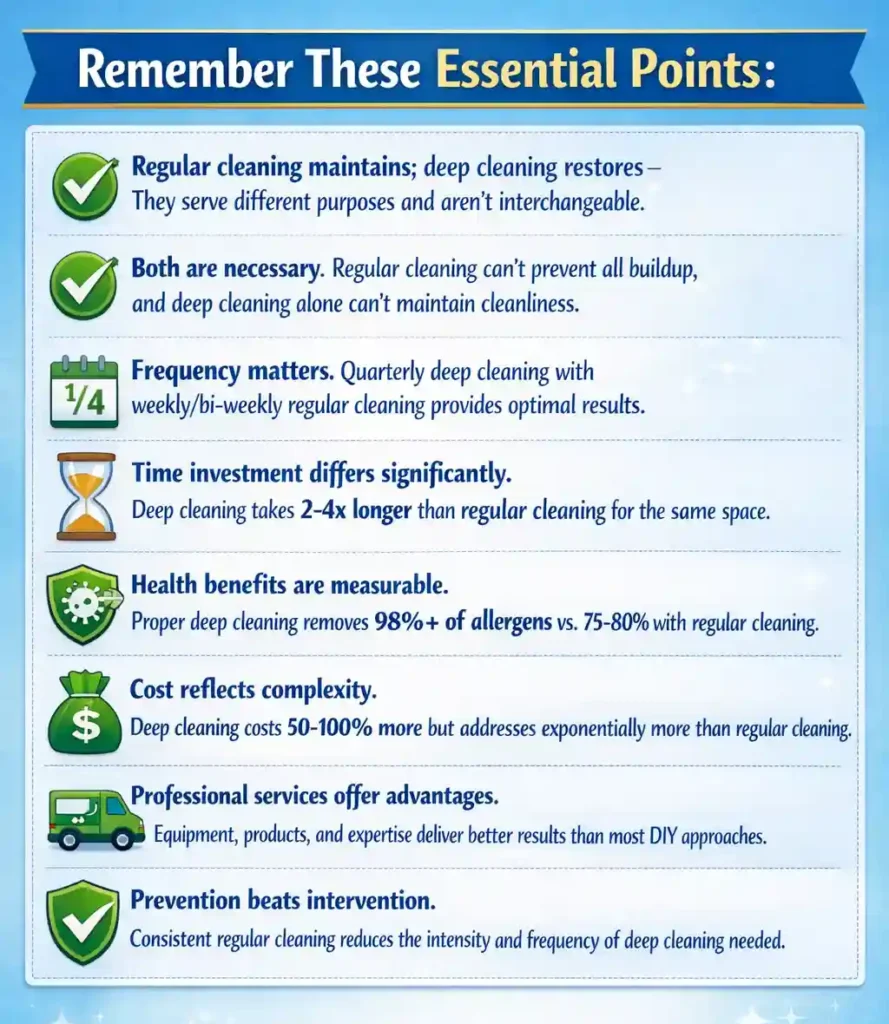
The difference between regular cleaning and deep cleaning isn’t just about intensity, it’s about purpose, methodology, and outcomes. Regular cleaning prevents your home from becoming dirty; deep cleaning returns it to a baseline clean state when prevention alone isn’t sufficient.
After a decade of working with thousands of homeowners across the UAE, the most successful approach I’ve observed combines both services strategically. Think of regular cleaning as preventative maintenance and deep cleaning as comprehensive servicing, both essential for long-term property care and occupant health.
Your next steps:
- Assess your current situation: When was your last deep clean? Is your regular cleaning consistent?
- Schedule appropriately: If it’s been more than 4 months since deep cleaning, book one now to reset your baseline
- Establish routine: Set up regular cleaning services to maintain that baseline
- Calendar deep cleaning: Schedule recurring quarterly deep cleans so they don’t get neglected
Ready to experience the difference? Contact Golden Spotless for professional cleaning services in your area that offer both regular and deep cleaning options. Ask for their detailed service checklists and compare them against the standards outlined in this guide.