
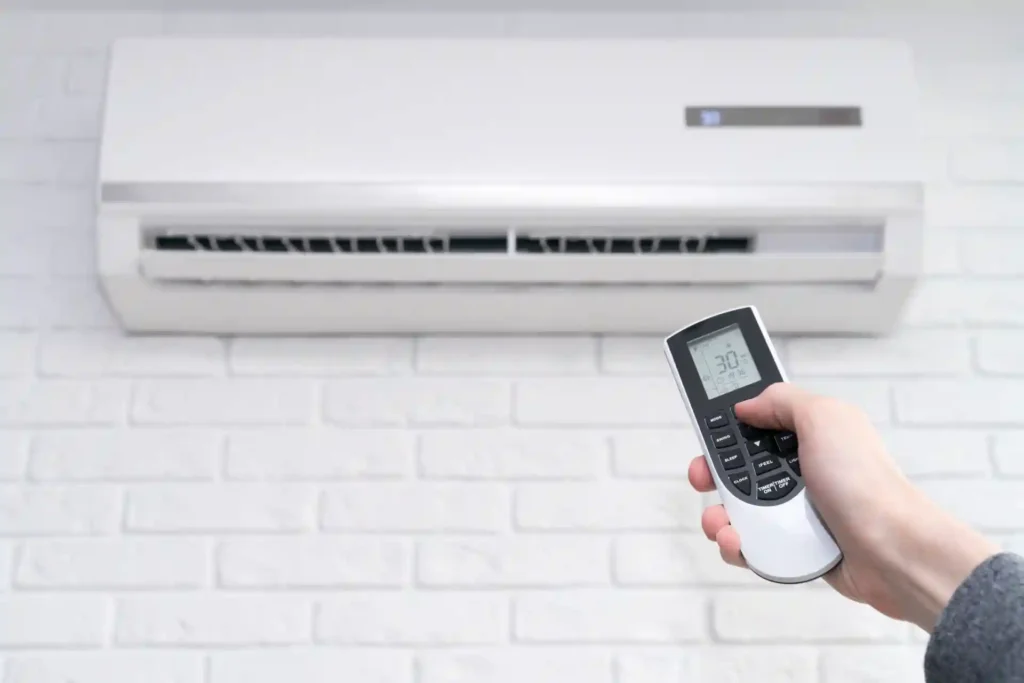
Why Is Your AC Not Cooling Properly?
Your AC is not cooling because of one or more of these issues: a dirty air filter blocking airflow, incorrect thermostat settings, a refrigerant leak, frozen evaporator coils, a clogged condenser unit, a faulty compressor, blocked vents, an undersized unit, electrical faults, or a malfunctioning thermostat. Most of these problems have straightforward fixes you can attempt before calling a technician.
Here is a quick overview of AC problems and fixes.
| Problem | DIY Fix | Professional Needed? | Time to Fix |
| Wrong thermostat setting | Yes (adjust settings) | No | 2 minutes |
| Dirty air filter | Yes (replace filter) | No | 10 minutes |
| Clogged condenser coils | Yes (rinse with hose) | Sometimes | 20–30 minutes |
| Frozen evaporator coils | Partial (turn off AC to defrost) | Yes, to find root cause | 2–24 hours |
| Refrigerant leak | No | Yes | 1–3 hours |
| Faulty compressor | No | Yes | Half to full day |
| Tripped circuit breaker | Yes (reset breaker) | Only if it keeps tripping | 5 minutes |
| Blocked air vents | Yes (open and clear vents) | No | 5 minutes |
| Undersized AC unit | No | Yes (system replacement) | Days |
| Faulty thermostat | Partial (replace batteries) | Yes, if wiring is faulty | 15–30 minutes |
Why AC is Not Cooling?
Here are the 10 most common causes of AC not cooling properly”
1. Incorrect Thermostat Settings
The thermostat is the brain of your AC system, and it is the first thing to check when your AC is not cooling. Many homeowners accidentally switch the fan setting from “Auto” to “On.” In “On” mode, the fan runs continuously even when the compressor is off, pushing uncooled air through the vents.
How to fix it:
- Set the mode selector to “Cool.”
- Set the fan to “Auto” (not “On”).
- Set the target temperature at least 5°F lower than the current room temperature.
- Wait 3–5 minutes for the compressor to engage.
If the system starts blowing cold air, problem solved. If not, move to the next step.
2. Clogged Air Filter
A clogged air filter is the single most common reason an AC runs but fails to cool a room. The filter traps dust, pollen, pet dander, and debris. When it becomes fully blocked, airflow drops sharply, the system struggles to move air across the evaporator coil, and cooling performance drops to near zero. In severe cases, restricted airflow causes the evaporator coil to freeze solid, shutting down the system entirely.
How to fix it:
- Turn off the AC at the thermostat.
- Locate the filter, usually inside the indoor air handler, behind a return air grille, or inside the furnace cabinet.
- Remove the filter and hold it up to a light source. If light does not pass through, replace it.
- Insert a new filter with the correct MERV rating for your system (MERV 8–11 suits most residential systems).
- Restart the AC and wait 5 minutes.
Filter replacement frequency:
- Standard 1-inch filters: every 30 days
- Thick 4–5 inch media filters: every 6–12 months
- Homes with pets or allergy sufferers: every 20–30 days
3. Blocked Outdoor Condenser Unit
The outdoor condenser unit expels heat absorbed from inside your home. It features a large coil wrapped around the unit with tightly spaced aluminum fins. Dirt, grass clippings, leaves, and airborne debris accumulate between the fins and choke airflow. When the condenser cannot release heat efficiently, refrigerant pressure rises, cooling capacity drops, and energy consumption climbs.
How to fix it:
- Turn off power to the outdoor unit at the disconnect box near the unit.
- Remove large debris by hand or with a soft brush.
- Spray the condenser fins from the inside out with a garden hose. Do not use a pressure washer, as it bends the fins.
- Apply a commercial foam coil cleaner, let it sit for 5 minutes, then rinse.
- Ensure at least 18–24 inches of clearance around the entire unit.
- Restore power and restart the system.
Clean the condenser unit at least once per year, preferably before summer.
4. Frozen Evaporator Coils
The evaporator coil sits inside your indoor air handler. Warm indoor air passes over it, the refrigerant inside absorbs heat, and cooled air returns to your rooms. When airflow across the coil drops, due to a dirty filter, blocked vents, or low refrigerant, the coil temperature drops below 32°F and ice forms on the coil. A frozen coil blocks all airflow, and your AC blows warm or no air at all.
Signs of a frozen evaporator coil:
- Frost or ice visible on the copper refrigerant lines coming out of the indoor unit
- Water pooling around the indoor unit as the ice melts
- Weak or warm airflow from all vents
- Higher-than-normal electricity bills
How to fix it:
- Turn the thermostat from “Cool” to “Fan Only”. This runs the blower without the compressor, forcing warm air over the frozen coil.
- Place towels around the indoor unit to catch dripping water.
- Allow the coil to defrost fully, this takes 2 to 24 hours depending on ice thickness.
- Replace the air filter once defrosted.
- Turn the system back to “Cool.”
If the coil freezes again within days, call a technician, low refrigerant or a malfunctioning blower motor is the likely culprit.
5. Refrigerant Leak
Refrigerant is the chemical that makes cooling possible. It absorbs heat from indoor air at the evaporator coil and releases that heat outside at the condenser coil. A refrigerant leak reduces the system’s capacity to absorb heat. The AC runs longer and longer cycles without reaching the set temperature. Eventually, refrigerant levels drop so low that the compressor overheats and fails.
Signs of a refrigerant leak:
- Hissing or bubbling sounds from the indoor or outdoor unit
- Ice forming on the evaporator coil or copper refrigerant lines
- The AC runs for hours without reaching the target temperature
- Higher electricity bills despite the same usage
Refrigerant handling requires EPA Section 608 certification. Never attempt to add refrigerant yourself. A licensed HVAC technician locates the leak with an electronic leak detector, repairs it, and recharges the system to manufacturer specifications (measured in pounds of refrigerant). At Golden Spotless Technical Services we provide complete range of AC service in Dubai including repairing and cleaning.
6. Faulty Compressor
The compressor is the heart of your AC system. It pressurizes the refrigerant and drives it through the system. A failing compressor causes the AC to run without producing any cold air, as the refrigerant no longer circulates efficiently. Compressor failure is one of the most expensive AC repairs, compressor replacement costs AED 1,500–4,000 or more depending on the unit’s capacity.
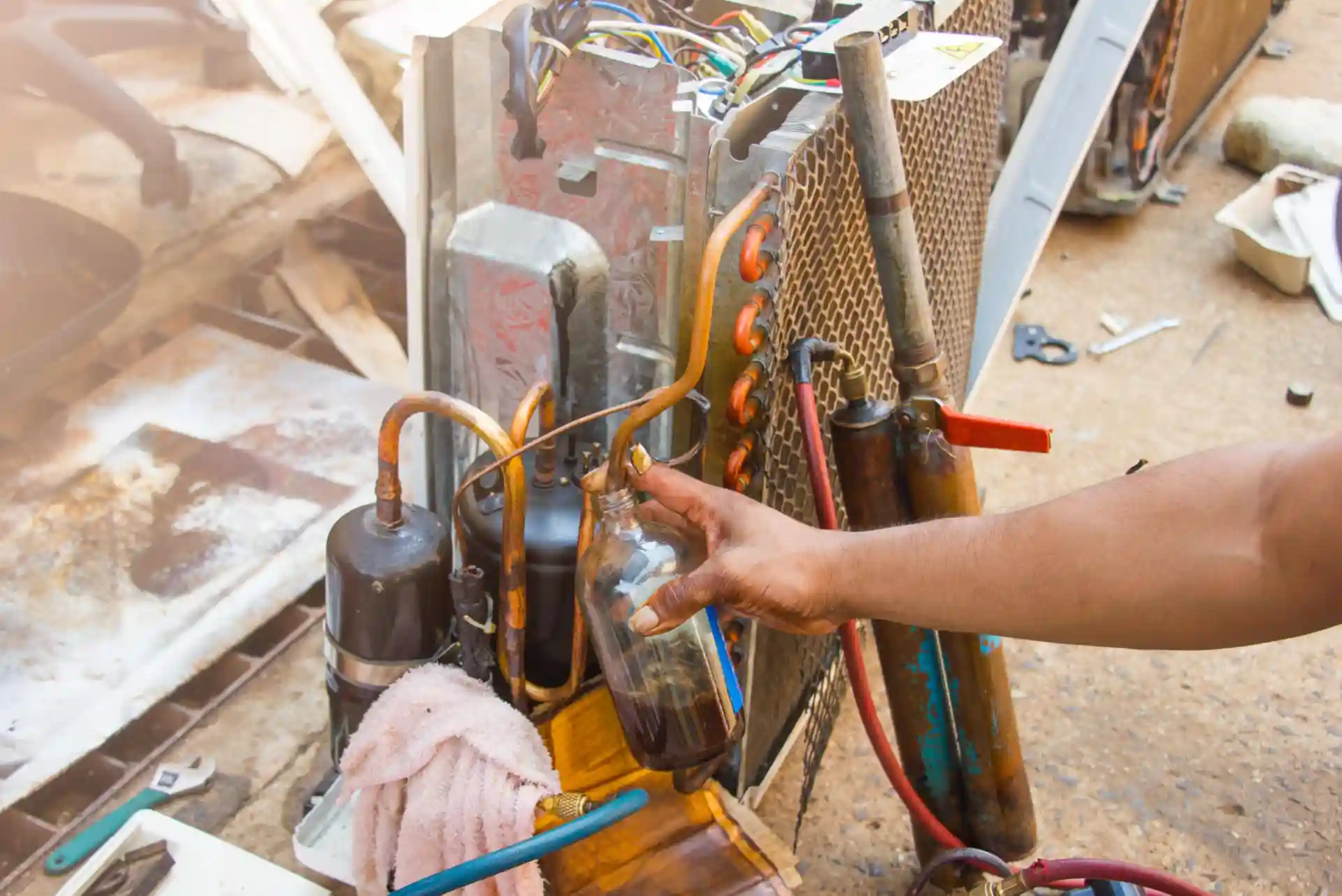
Signs of compressor failure:
- AC turns on but blows warm air
- Loud clanking, banging, or clicking from the outdoor unit
- The outdoor unit vibrates heavily on startup
- Circuit breaker trips when the outdoor unit tries to start
Compressor repair or replacement requires a licensed technician. In many cases where the unit is over 10 years old, replacing the entire outdoor unit is more cost-effective than replacing only the compressor.
7. Electrical Issue
Air conditioners draw significant electrical current, especially the outdoor compressor. A power surge, short circuit, or overloaded circuit trips the breaker, cutting power to the outdoor unit while the indoor blower continues running. The result: the fan blows air, but no cooling occurs because the compressor is offline.
How to fix it:
- Go to the electrical panel and find the breaker labeled for the AC or air handler.
- If the breaker is in the “Trip” position (midway between On and Off), push it fully to “Off” first, then firmly back to “On.”
- Wait 30 minutes before restarting the AC to let the compressor pressure equalize.
- Restart and monitor for another trip.
If the breaker trips again within minutes or repeatedly over a few days, stop resetting it. A failing capacitor, short-circuited compressor, or wiring fault is causing the overload this requires a technician.
8. Blocked Air Vents
Every supply vent in your home must be open and unobstructed. Homeowners sometimes close vents in unused rooms hoping to save energy, but this raises static pressure inside the duct system. Higher pressure forces the blower to work harder while delivering less airflow to occupied spaces. The evaporator coil cools less air per cycle, and some rooms never reach the set temperature.
How to fix it:
- Open all supply vents throughout the home, including in unused rooms.
- Remove furniture, curtains, rugs, and other objects blocking vent covers.
- Vacuum the vent covers to clear dust buildup blocking the slats.
- Check return air grilles (the larger vents that pull air in) and ensure they are fully open and unobstructed.
9. Undersized Air Conditioner
An AC unit that is too small for the space it serves will run continuously on hot days and never reach the set temperature. Cooling capacity is measured in British Thermal Units per hour (BTUh) or tons (1 ton = 12,000 BTUh). General sizing rules recommend approximately 20 BTU per square foot of living space, but climate, ceiling height, insulation quality, window area, and sun exposure all affect the correct size.
In the UAE and similar hot climates, undersizing is a frequent issue, systems must work against outdoor temperatures exceeding 45°C (113°F) for months at a time.
Solutions:
- Add a ductless mini-split unit (brands like Daikin, Mitsubishi, or Carrier offer 9,000–24,000 BTU wall-mounted units) to supplement cooling in hot zones.
- Have a qualified HVAC engineer perform a Manual J load calculation to determine the correct system size.
- Replace the undersized unit with one properly sized for the space.
10. Malfunctioning Thermostat
A faulty thermostat sends incorrect signals to the AC, or no signals at all. It may read the room temperature inaccurately, causing the system to stop cooling prematurely, or it may fail to send the “start” command to the compressor.
How to fix it:
- Replace the thermostat batteries, dead batteries cause erratic behavior even in smart thermostats.
- Clean the inside of the thermostat housing with a soft brush to remove dust from the sensors.
- Verify the thermostat is not in direct sunlight or near a heat source, as this causes it to read temperatures incorrectly.
- If the thermostat screen is blank or unresponsive after new batteries, the unit needs replacement.
Smart thermostats provide more accurate temperature control and self-diagnostics.
How to Troubleshoot AC Not Cooling?
Follow this checklist in order before calling a technician. Completing these steps can resolve the problem 60–70% of the time without a service visit.
- Check the thermostat: set it to Cool mode, Auto fan, temperature 5°F below current room temp.
- Inspect the air filter: replace it if it appears gray, brown, or clogged.
- Check all vents: open every supply and return vent in the home.
- Inspect the outdoor unit: clear debris and rinse condenser fins with a garden hose.
- Look at the copper refrigerant lines: check for frost or ice near the indoor unit.
- Check the circuit breaker panel: reset any tripped breakers for the AC circuit.
- Verify power to the outdoor disconnect: the 240V disconnect box next to the outdoor unit must be in the ON position.
- Defrost frozen coils if needed: switch to Fan Only mode and wait 2–24 hours.
- Restart the system: set the thermostat back to Cool and monitor for 15–20 minutes.
- Call a technician: if the system still does not cool or if the breaker trips again.
When to Call a Professional
Your AC is not cooling for one or more fixable reasons. Start with the simplest checks and work through the troubleshooting checklist systematically. Most cooling failures that homeowners can fix take under 30 minutes and cost nothing but a replacement filter.
Contact a licensed HVAC technician immediately when you observe:
- Ice on refrigerant lines or the outdoor unit indicates low refrigerant or a blocked coil requiring professional diagnosis.
- Hissing, bubbling, or banging sounds from the outdoor unit points to refrigerant leaks or compressor failure.
- Circuit breaker trips repeatedly signals an electrical fault that is dangerous to ignore.
- The AC does not start at all capacitor, contactor, or compressor failure.
- The system is more than 10 years old and cooling performance has declined steadily replacement may be more cost-effective than repeated repairs.
For residents in the UAE, professional AC service is essential before the summer season to ensure your system handles temperatures that regularly exceed 45°C. A certified technician inspects refrigerant levels, cleans coils, tests electrical components, and verifies the system is sized correctly for your space. At Golden Spotless we have licensed HVAC technicians and electricians for all your AC related needs. Call us now.
Frequently Asked Questions
Q: What should I check first when my AC is not cooling?
The first thing to check when your AC is not cooling is the thermostat. Verify it is set to “Cool” mode with the fan on “Auto,” and that the target temperature is lower than the current room temperature. After confirming the thermostat settings, inspect the air filter, a clogged filter is the most common cause of reduced cooling in residential AC systems.
Q: Can I fix my AC not cooling in one session without a technician?
You can resolve the most common causes of AC not cooling in a single session lasting 30–60 minutes. Replacing a dirty filter, clearing condenser debris, resetting a tripped breaker, opening blocked vents, and defrosting a frozen coil are all DIY tasks. However, refrigerant leaks, compressor failure, and wiring faults require a licensed HVAC technician and cannot be safely completed as DIY repairs.
Q: How often should I service my AC to prevent it from stopping cooling?
You should service your AC professionally at least once per year, ideally 4–6 weeks before peak summer temperatures arrive. Annual AC service includes refrigerant level checks, coil cleaning, electrical inspection, and thermostat calibration. In hot climates where AC runs 8–12 hours daily, semi-annual servicing significantly extends system life and prevents mid-season cooling failures.


