
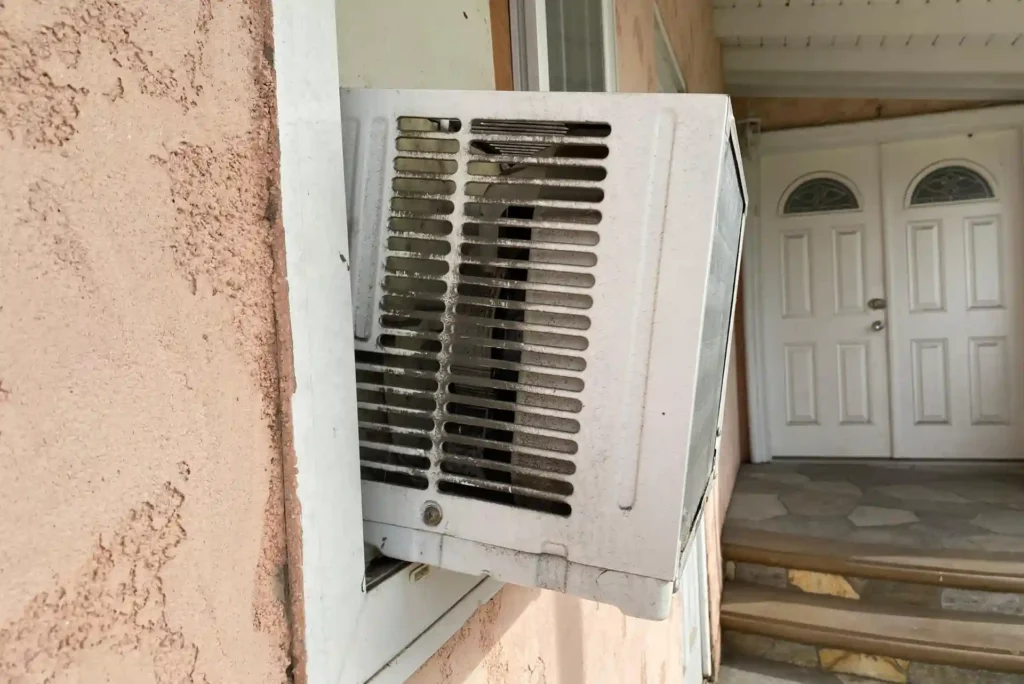
Why is Your Window AC Compressor Not Turning On?
A window AC compressor not turning on is most commonly caused by a tripped circuit breaker, a dirty air filter blocking airflow, a faulty capacitor, low refrigerant levels, or a broken thermostat. These issues prevent the compressor from starting its cycle. Most problems can be diagnosed and resolved within 30-60 minutes using basic tools.
For residents in the Dubai, extreme heat accelerates compressor wear, coil fouling, and refrigerant loss making professional annual servicing essential, not optional. If your troubleshooting points to refrigerant issues, wiring faults, or a failed compressor motor, it is time to bring in a certified technician.
A quick overview of issues and fixes:
| Issue | Likely Cause | Fix Method | Time Needed |
| No sound, no cooling | Power/electrical fault | Reset breaker, test outlet | 5–10 min |
| Fan runs, no cooling | Bad capacitor or low refrigerant | Replace capacitor or recharge | 30–60 min |
| Unit turns on/off rapidly | Dirty filter or frozen coils | Clean filter, defrost unit | 2–4 hours |
| Compressor hums but doesn’t start | Failed capacitor | Replace start/run capacitor | 20–30 min |
| Compressor overheats and shuts off | Blocked condenser or overload relay | Clean coils, replace relay | 30–45 min |
| Thermostat shows wrong temp | Faulty thermostat or sensor | Recalibrate or replace | 15–30 min |
Understand the Window AC Compressor
The window AC compressor not turning on is a symptom, not a single diagnosis. The compressor relies on a chain of electrical and mechanical components, if any one link breaks, the compressor stays silent. Understanding this chain helps you isolate the fault fast.
The compressor starts only when three conditions are met:
- Adequate power reaches the unit (240V for most window ACs)
- The thermostat signals a cooling demand
- The start capacitor delivers a voltage surge to kick the motor
If any condition fails, the compressor will not turn on, even if every other part works perfectly.
What are the Causes of Window AC Compressor Not Turning On?
1. Blown Fuse
A tripped breaker is the most common reason a window AC compressor stops working. Window air conditioners draw 5–15 amps depending on their BTU rating. A power surge, overload, or loose wiring trips the breaker automatically.
How to fix it:
- Go to your electrical panel and look for a breaker in the “off” or middle position.
- Flip it fully to “off,” then back to “on.”
- Wait 3 minutes before turning the AC back on to let pressure equalize.
- If the breaker trips again immediately, the problem is electrical, call a technician.
2. Faulty Run Capacitor
The capacitor is the single most common part that fails in window AC units and prevents the compressor from starting. It stores and releases a burst of electrical energy to start the compressor motor. A weak or dead capacitor means the motor never gets that initial jolt.
Symptoms of a bad capacitor:
- Compressor hums for 1–3 seconds, then shuts off
- The fan runs but the compressor stays silent
- The unit trips the breaker when it tries to start
How to test and replace a capacitor:
- Unplug the AC unit completely, capacitors hold lethal voltage even when unpowered.
- Remove the back panel (usually 4–6 screws).
- Locate the capacitor, a cylindrical or oval-shaped component with two or three terminals.
- Use a multimeter with capacitance mode to test its microfarad (µF) rating against the label.
- A reading more than 10% below the rated µF means it has failed.
- Replace with an identical µF and voltage-rated capacitor.
Safety note: Always discharge a capacitor using a 20,000-ohm resistor before touching terminals.
3. Clogged Air Filter
A severely clogged air filter restricts airflow so badly that the compressor overheats and triggers its thermal overload switch, an automatic shutoff that protects the motor. When this switch trips, the compressor will not restart until the unit cools down.
Filter cleaning schedule:
- Light use (4–6 hours/day): Clean every 30 days
- Heavy use (8–12 hours/day): Clean every 14 days
- Dusty environments (near roads, construction): Clean every 7 days
How to clean the filter:
- Remove the front panel and slide out the filter.
- Rinse with warm water, do not use soap on foam filters.
- Let it dry completely (30–60 minutes) before reinstalling.
- If the filter is torn or deformed, replace it entirely.
4. Frozen Evaporator or Condenser Coils
Ice buildup on the evaporator coils blocks airflow completely, forcing the compressor to work harder until it overheats and shuts down. This is one of the most misunderstood causes of a window AC compressor not running.
Signs of frozen coils:
- Ice visible on copper lines or coils
- Water dripping from the front of the unit
- The fan blows warm or slightly cool air only
How to defrost the unit:
- Turn the AC off and set the fan to “Fan Only” mode.
- Let it run for 2–3 hours to melt ice naturally (do not use heat guns).
- Place towels under the unit to catch meltwater.
- Once defrosted, clean the filter and coils before restarting in cool mode.
5. Low Refrigerant (Freon) Levels
Refrigerant does not get “used up” in a normal AC cycle if levels are low, it means there is a leak. Low refrigerant causes the compressor to work against incorrect pressure, triggering safety cutoffs or causing the compressor to fail to complete its cycle.
Signs of low refrigerant:
- AC runs continuously but never cools the room
- Hissing or bubbling sounds near the unit
- Ice forming on the refrigerant lines
Important: Handling refrigerant requires professional skills as per Dubai municipality rules. Do not attempt to recharge refrigerant yourself contact a licensed HVAC technician.
6. Thermostat Malfunctioning
If the thermostat is set above the room temperature, the AC will not signal the compressor to start. This is the simplest fix but a malfunctioning thermostat sends no signal at all, mimicking a dead compressor.
How to test the thermostat:
- Set the temperature 5–8°F below the current room reading.
- Wait 2–3 minutes for the compressor to engage.
- If it still does not start, place a separate digital thermometer near the sensor.
- If the AC’s display reads differently from the thermometer by more than 3°F, the sensor needs recalibration or replacement.
7. Compressor Overload Protector Tripped
The compressor contains a thermal overload protector that cuts power to the motor when it overheats. This safety device resets automatically after 30 minutes of cooling but if the underlying cause is not fixed, it will trip repeatedly.
What causes repeated overload trips:
- Ambient temperature above 115°F (46°C) common in the Middle East
- Blocked condenser coils preventing heat dissipation
- Low voltage supply below the unit’s rated requirement
How to fix it:
- Turn the AC off and unplug it for 30–45 minutes.
- Clean the condenser coils on the back of the unit with a soft brush or coil cleaning spray.
- Ensure the unit has 12 inches of clearance on all sides for airflow.
- Check your outlet voltage with a multimeter, it should read 220–240V for most window ACs.
8. Faulty Compressor Motor Windings
If all other components test correctly, the compressor motor itself may have failed. Burned or shorted windings are a terminal diagnosis, the compressor cannot be repaired and must be replaced. In most cases, replacing the compressor costs 70–80% of the price of a new unit, making replacement more economical.
How to test motor winding:
- Disconnect power and discharge the capacitor.
- Locate the compressor terminals (C, S, R, Common, Start, Run).
- Use a multimeter in resistance mode.
- Measure resistance between C–S, C–R, and S–R.
- A reading of zero (short circuit) or infinite resistance (open circuit) on any pair confirms winding failure.
How to Diagnose Window AC Compressor Not Turning On?
Follow this sequence to find the fault efficiently without unnecessary disassembly:
- Check power supply first. Confirm the unit is plugged in, test the outlet with another device, and inspect the circuit breaker.
- Set the thermostat correctly. Lower it 5–8°F below room temperature and wait 3 minutes.
- Listen carefully when you power on. A hum with no startup = bad capacitor. Complete silence = power fault. Fan runs but no cooling = compressor or refrigerant issue.
- Inspect the filter. Remove and check within the first 10 minutes of diagnosis.
- Check for ice. Look at the coils and refrigerant lines. If frozen, defrost before proceeding.
- Test the capacitor. Use a multimeter to confirm its µF rating.
- Clean condenser coils. Use a soft brush or compressed air to clear debris.
- Allow overload reset. Unplug for 30–45 minutes if overheating is suspected.
- Check refrigerant lines. Listen for hissing and look for oil stains near fittings.
- Test compressor windings. Only after ruling out all other causes.
Tools you need to diagnose a window AC compressor.
| Tools | Purpose |
| Digital multimeter | Test voltage, continuity, capacitance |
| 20,000-ohm resistor | Safely discharge capacitor |
| Soft coil brush | Clean condenser coils |
| Replacement capacitor | Fix most compressor startup failures |
| Non-contact thermometer | Check coil and compressor temperatures |
| Fin comb | Straighten bent condenser fins |
Conclusion
A window AC compressor not turning on is a fixable problem in the majority of cases. Start with the simplest checks before moving to electrical components like the capacitor and overload protector. For reliable window AC repair service in Dubai, contact us now. We offer certified HVAC technicians with same-day availability across all emirate zones.
Our team handles everything from capacitor replacements and coil cleaning to full compressor diagnostics and refrigerant recharges using OEM-grade parts with a service warranty. Whether your unit needs a quick fix or a full inspection, Golden Spotless delivers transparent pricing and expert results you can trust.
Frequently Asked Questions (FAQ)
Q: Why is my window AC fan running but the compressor is not turning on?
A window AC fan running with no compressor activation almost always points to a failed start capacitor or a tripped thermal overload protector. The fan motor runs on a separate circuit from the compressor, so it can operate independently even when the compressor cannot start. Test the capacitor with a multimeter if its microfarad reading is more than 10% below the rated value, replace it immediately.
Q: What is the most common reason a window AC compressor stops working?
The most common reason a window AC compressor stops working is a failed run/start capacitor. Capacitors degrade over 3–5 years of use, especially in high-heat environments. The second most common cause is a dirty air filter that triggers the thermal overload protector. Together, these two issues account for over 60% of compressor startup failures in window units.
Q: Can I run my window AC if the compressor is not working?
Running a window AC with a non-functional compressor will not cool your room the fan will circulate warm air only. Running it in this state for extended periods wastes electricity and can stress other components like the fan motor. Turn the unit off until the compressor fault is diagnosed and resolved.
Q: What should I check first when my window AC compressor won’t turn on?
The first thing to check when a window AC compressor won’t turn on is the circuit breaker and power supply. Confirm the outlet delivers the correct voltage (220–240V) using a multimeter, and reset any tripped breaker. Then lower the thermostat 5–8°F below room temperature and wait 3 minutes. These two steps alone resolve roughly 25–30% of compressor startup complaints without any disassembly.


