How to Calculate Paint Quantity?
Paint quantity calculation is a skill that comes with experience. Professional painters develop an eye for surface conditions, absorption rates, and coating systems that take years to calibrate. Without that experience, even the most careful DIY calculations can miss hidden variables, a porous wall that drinks twice the expected paint, a texture that adds 30% to coverage needs, a color change that silently demands a third coat.
This guide gives you the formulas so you understand exactly what goes into an accurate estimate. But if you’re looking at a significant project, a full apartment, a villa exterior, or anything where getting it wrong is expensive, our expert painters handle material calculations as part of every job.
For those ready to measure and calculate themselves, let’s walk through the exact method.
Understanding Paint Coverage Basics
Before diving into calculations, you need to understand how paint coverage works. Every paint can lists coverage information on the label, typically showing how many square meters one liter will cover.
| Paint Type | Coverage per Liter | Notes |
|---|---|---|
| Interior wall paint | 10–12 m²/L | Smooth, previously painted surface |
| Exterior paint | 8–10 m²/L | Thicker formulation, weather resistance |
| Primer | 12–15 m²/L | Seals porous surfaces |
| Metal / anti-rust paint | 8–10 m²/L | Rough texture after treatment |
| Industrial pipe coating | 6–8 m²/L | High-protection, thick-build |
| Tank protective coating | 5–7 m²/L | Corrosion-resistant formulation |
Note: Always verify the coverage rate on your specific paint label.
How to Calculate Paint Quantity?
The fundamental formula for paint calculation is refreshingly simple. Here’s what you need to know.
Paint needed (liters) = [(Total area − Non-painted area) ÷ Coverage per liter] × Number of coats × 1.15
| Step | Action | Example |
|---|---|---|
| 1 | Measure total surface area (m²) | 42 m² |
| 2 | Subtract windows, doors, fixed furniture | −5 m² = 37 m² |
| 3 | Divide by paint’s coverage rate (L/m²) | 37 ÷ 10 = 3.7 L |
| 4 | Multiply by number of coats | × 2 = 7.4 L |
| 5 | Add 15% waste buffer | × 1.15 = 8.5 L |
The 1.15 multiplier accounts for paint lost in trays, on brushes, from overlapping strokes, and on porous surfaces. Industry estimates show homeowners waste 20–30% of purchased paint due to overbuying, this formula prevents both waste and shortfall.
How to Calculate Paint Quantity for a Wall?
Wall painting is the most common scenario, so let’s break this down with a concrete example that shows you exactly how the math works.
Example: Painting a bedroom wall
Your bedroom wall measures 4 meters wide and 3 meters high. It has one window measuring 1.5 meters wide by 1.2 meters high.
Step 1: Calculate total wall area. 4 meters × 3 meters = 12 square meters
Step 2: Calculate window area to subtract. 1.5 meters × 1.2 meters = 1.8 square meters
Step 3: Calculate net paintable area. 12 square meters – 1.8 square meters = 10.2 square meters
Step 4: Apply paint coverage rate. Your paint covers 10 square meters per liter (check your specific paint label). 10.2 square meters ÷ 10 square meters per liter = 1.02 liters for one coat
Step 5: Account for number of coats. You’re painting two coats over a light-colored existing wall. 1.02 liters × 2 coats = 2.04 liters
Step 6: Add waste buffer. 2.04 liters × 1.15 = 2.35 liters total needed
You would buy a 3-liter can, giving you enough paint plus some extra for future touch-ups. Never round down when buying paint. Always round up to the next available can size.
For multiple walls in a room, calculate each wall separately, then add them together. This accounts for different window and door placements on each wall. The extra few minutes of calculation saves you from expensive mistakes.
How to Calculate Paint Quantity for a Room?
Calculating paint for an entire room involves measuring all four walls and the ceiling if you’re painting it. Here’s a streamlined approach.
- Measure your room dimensions. Note the length and width of the room, plus the ceiling height. Let’s use a standard Dubai apartment bedroom: 4 meters long, 3.5 meters wide, with 2.8 meter ceiling height.
- Calculate all wall areas combined. Use this quick formula: Perimeter × Height = Total wall area. Perimeter = (Length + Width) × 2
- For our example room: Perimeter = (4 + 3.5) × 2 = 15 meters Wall area = 15 meters × 2.8 meters = 42 square meters
- Subtract openings. Measure all doors and windows. A standard door is about 2 square meters. A typical window is 1.5 to 2 square meters. Our example room has one door (2 square meters) and two windows (3 square meters total).
- Net wall area = 42 – 5 = 37 square meters
- Calculate ceiling area if painting it. Length × Width = Ceiling area 4 meters × 3.5 meters = 14 square meters
- Total paintable area = 37 square meters (walls) + 14 square meters (ceiling) = 51 square meters
- Apply the formula. Assuming 10 square meters per liter coverage and two coats: (51 ÷ 10) × 2 × 1.15 = 11.73 liters
You would buy 12 liters of paint, likely four 3-liter cans or three 4-liter cans depending on what’s available. This method works for any room size. Just plug in your measurements and follow the same steps.
How to Calculate Paint Quantity for Building?
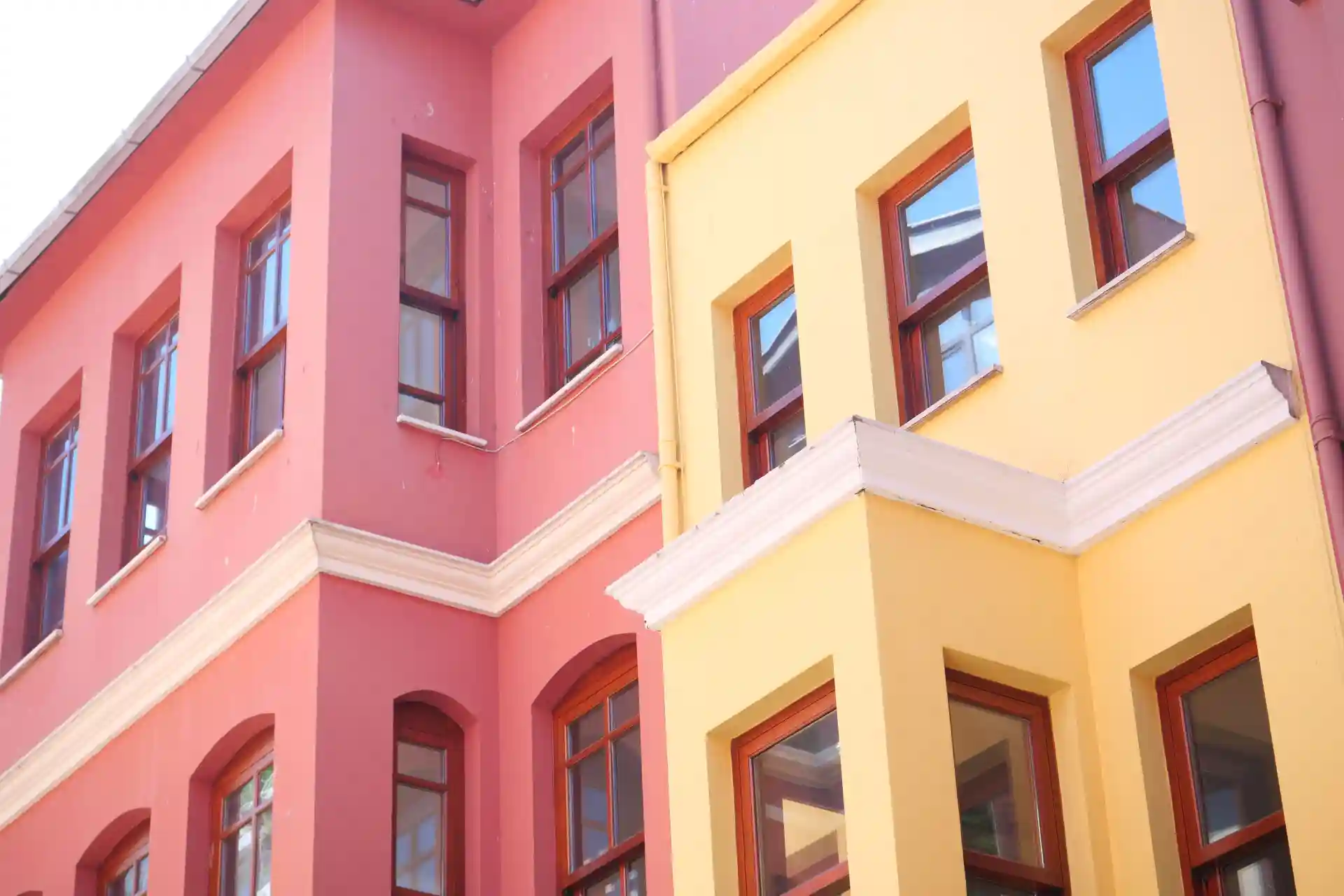
Calculating paint for entire buildings requires a more systematic approach due to the scale involved. Whether you’re painting a villa exterior or a small commercial building, break it down into manageable sections.
Break large buildings into sections:
- Perimeter = (Length + Width) × 2
- Gross wall area = Perimeter × Total building height
- Subtract openings – windows (~2–3 m² each), doors (~2 m² each)
- Add gable area = (Base × Height) ÷ 2 per triangular gable
Worked example – 2-storey villa (12 m × 10 m, 6 m height, 15 windows, 3 doors):
| Element | Calculation | Area |
|---|---|---|
| Gross walls | 44 m × 6 m | 264 m² |
| 15 windows | 15 × 3 m² | −45 m² |
| 3 doors | 3 × 2 m² | −6 m² |
| 2 gable ends | (10 × 2) ÷ 2 × 2 | +20 m² |
| Net area | 233 m² |
Exterior paint (9 m²/L), two coats: (233 ÷ 9) × 2 × 1.15 = ~60 L
How to Calculate Paint Quantity for Steel Structure?
Painting steel structures like gates, railings, or structural beams requires different considerations than walls due to irregular shapes and surface preparation needs.
- For simple steel shapes like flat gates or railings, measure the total surface area just like walls. A gate 2 meters wide and 1.5 meters high has 3 square meters of surface area per side. If painting both sides: 3 × 2 = 6 square meters total
- Account for bars, tubes, and complex shapes. For tubular railings or decorative ironwork, estimate by measuring the length of all tubes and multiplying by their circumference. For a 2-inch diameter tube, the circumference is about 16 centimeters (0.16 meters). If you have 20 meters of railing: 20 meters × 0.16 meters = 3.2 square meters
- Steel requires primer. Bare steel must be primed before painting to prevent rust. Calculate primer separately using similar coverage rates (usually 12 to 15 square meters per liter for metal primer).
- Metal paint coverage is similar to wall paint at 10 to 12 square meters per liter, but steel surfaces are often rough or textured from rust treatment, reducing coverage to 8 to 10 square meters per liter.
For our 6-square-meter gate example with primer and two coats of paint: Primer: (6 ÷ 12) × 1 × 1.15 = 0.58 liters Paint: (6 ÷ 10) × 2 × 1.15 = 1.38 liters. You’d buy 1 liter of metal primer and 2 liters of metal paint. Always use paint specifically formulated for metal surfaces, regular wall paint won’t adhere properly or protect against corrosion.
How to Calculate Paint Quantity for Pipe?
Calculating paint for pipes and pipelines requires measuring the cylindrical surface area, which uses different math than flat surfaces.
The formula for pipe surface area is: π × Diameter × Length
Where π (pi) = 3.14, Diameter is the pipe’s outer diameter, and Length is how much pipe you’re painting.
Example calculation: You’re painting a 6-inch diameter pipe that’s 50 meters long. Convert 6 inches to meters: 6 inches = 0.15 meters Surface area = 3.14 × 0.15 meters × 50 meters = 23.55 square meters
For multiple pipes, calculate each separately and add them together. If you have five pipes of the same size: 23.55 × 5 = 117.75 square meters total
Industrial pipe coating typically requires specialized paints with coverage rates of 6 to 8 square meters per liter because these paints are thick and protective. Using 7 square meters per liter with two coats: (117.75 ÷ 7) × 2 × 1.15 = 38.6 liters
Round up to 40 liters for a complete job with waste allowance.
For pipe fittings (elbows, tees, valves), add 15 to 20 percent to your pipe surface area calculation to account for these irregular shapes. They’re difficult to measure precisely but add significant surface area.
Industrial painting projects often involve safety requirements, surface preparation standards, and specific coating systems that require professional expertise. For complex piping systems, consulting with industrial coating specialists ensures proper material selection and application.
How to Calculate Paint Quantity for Tanks?
Water tanks, fuel tanks, and storage tanks require accurate paint calculation because they involve both exterior and interior surfaces with different coating requirements.
Cylindrical tanks require three area calculations:
| Surface | Formula | Example (2 m dia, 3 m tall) |
|---|---|---|
| Side wall | π × D × H | 3.14 × 2 × 3 = 18.84 m² |
| Top (circle) | π × r² | 3.14 × 1² = 3.14 m² |
| Bottom (circle) | π × r² | 3.14 m² |
| Total | 25.12 m² |
Tank coating (6 m²/L), two coats: (25.12 ÷ 6) × 2 × 1.15 = 9.6 L
Rectangular tanks: Calculate each face as (L × W) or (L × H), sum all six sides.
Interior tank coating requires complete drainage and drying before painting. Many tanks also need primer specific to the tank material (concrete, steel, fiberglass). Always verify that your paint is approved for potable water contact if the tank stores drinking water.
How Much Paint Per m2?
The amount of paint needed per square meter depends on the type of paint and surface, but here are standard estimates you can use:
Average Paint Coverage
- 1 liter of paint = 8 to 12 m² (one coat)
Per m² Calculation
- For 1 m² (one coat) – about 0.08 to 0.12 liters
- For 2 coats (recommended) – about 0.16 to 0.24 liters per m²
Surface Differences
- Smooth walls (plaster, gypsum): closer to 10–12 m² per liter
- Rough surfaces (brick, concrete): closer to 6–8 m² per liter
- New walls (unprimed): may absorb more paint
Quick Formula
- Room wall area = 50 m²
- Paint needed = 50 × 0.2 = 10 liters
Get Your Right Paint Calculation Now
For large or complex projects where precision is critical or if you’re uncomfortable with calculations, simply contact our professional best painters in Dubai provide free estimates that include accurate material calculations. They factor in surface conditions, required preparation, and coating systems that homeowners might overlook. Sometimes the peace of mind from professional assessment is worth consulting an expert, especially for expensive or high-visibility projects.
Frequently Asked Questions
How much paint do I need for a 12×12 room?
A 12 ft × 12 ft room (≈3.6 m × 3.6 m) with 8 ft ceilings has approximately 30 m² of net wall area after subtracting a door and window. Two coats with a waste buffer requires ~7 L for walls plus an additional 4 L if painting the ceiling.
How do I calculate paint for textured walls?
Reduce the coverage rate by 25-30%. If your paint normally covers 10 m²/L, use 7–7.5 m²/L for textured or porous surfaces.
How many coats do I need?
- Light color over light: 2 coats
- Dark over light or light over dark: 2-3 coats
- Bare surface or dramatic color change: 1 primer coat + 2-3 paint coats
Is leftover paint wasted?
Properly sealed paint lasts 2-3 years stored in a cool, dry location. Leftover paint is valuable for future touch-ups, making slight overbuy a reasonable strategy.